
Silence, Snap!
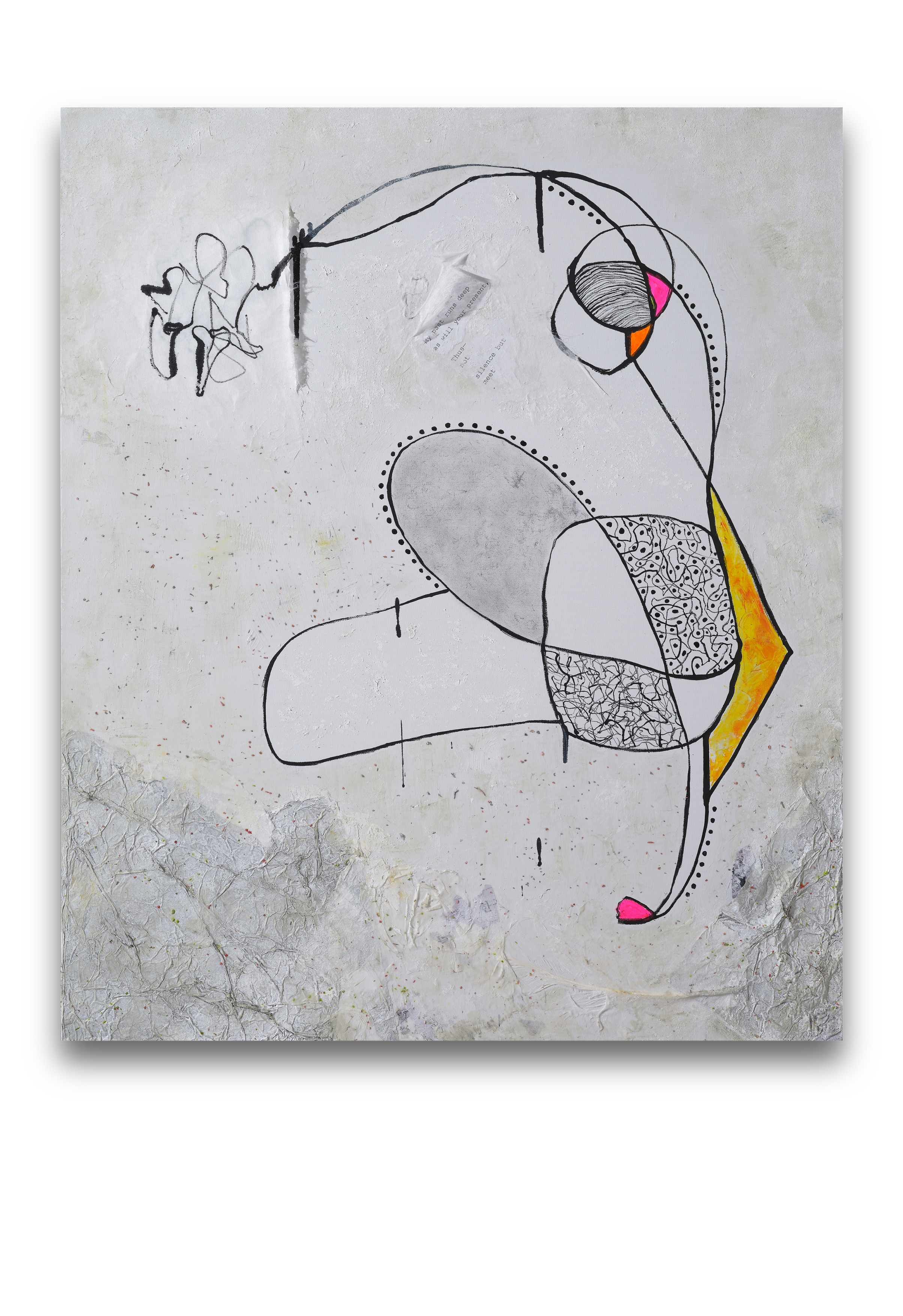
Life1002. Offering, Mixed media, layered tactile pieces on canvas, 60×73㎝ (Text in canvas is an English poem ‘Breath,02’ first published in Eunoia Review (2026) )
I hear that silent parties have been held for some time now around the Han River and Yeouido, with people dancing in headphones. Yoga, running, outdoor movies, and other events are said to be held in silence as well. The idea of enjoying them without causing noise pollution to those around made good sense to me.
On the other hand, a scene exactly the opposite came to mind as well. A street protest filling the air with noise in every direction. A European curator I meet these days for advice by video call every week once told me that the sight of a protest she saw in Seoul was a little scary. Her story brought me back to the time when tear gas entered my twenty-year-old life. It was 1996, when South Korea had forty million people, not fifty million, and there were “a million fellow students.”
Because it was August, during the school vacation, I learned about it through the news. The media at the time called it “an incident”; later, some called it “an uprising,” and while some put the name of an organization before it, others put the name of a university.
Whatever happened to the original slogans—the thousands of students who had been confined inside the school buildings for days were dragged out and taken into custody after negotiating over a “guarantee of safe return home.” Only later did I learn that my best friend from high school, with whom I have now long since lost touch, had been there too. As I cleaned up the university, almost in ruins, its main gate torn apart by the authorities and its buildings ripped apart by the students, I wondered, How could something like this have happened? I sometimes think that the stones I picked up and cleared away then took root inside me as the seed of a “border dweller”—shutting up my ears first whenever voices are raised, convinced that only their own words are right. Paradoxically, I may have become someone who only speaks and never listens, because of that….
Before I knew it, thirty years had passed, and I heard about the archival exhibition on the August 1996 Yonsei University incident. Just as the exhibition title What Happened, What Did Not Happen suggests, perhaps it was because the breadth and depth of our experiences and the layers of our emotions were too different; we may have made assumptions about one another, but we had never talked about it among ourselves. I had hesitated even to include a piece about my memories from that time in my first book, and it took a different kind of courage, quite apart from the courage it took to publish a book. When the group chat room broke the silence and came alive with news of the exhibition, one of my seniors, a university professor, said that the incident had been the trigger for a change in her field of study.
It was an “incident” that had overturned or twisted our worlds, each in our own way, to a greater or lesser degree. Why had we never talked about it all these years? Was it that we could not? That we did not want to? That we were afraid…. As though it were the man Who Shall Not Be Named, Voldemort in Harry Potter.
Wanting to check my own hazy memories, I rushed to the exhibition. My heart flitted this way and that at the sight of the old wall posters, handwritten group journals, hats and furnishings, and photographs of poignant notes saying ‘I want to go home’. On my way out after attending the academic symposium held in a building deep inside the campus, a thought briefly crossed my mind: people say that memories cling to emotions or sensations, and that it is good to give emotions specific names, but perhaps feelings like these had no answer.
As I walked down the long Baekyang-ro, absently reading the banners that seemed unusually numerous that day, I suddenly found myself chuckling. There they were, one after another, the wonderfully odd and lively banners put up by young people celebrating their graduation—some putting out an APB for an escaped criminal, others proclaiming that “our Dong-gu made it.” As I gently sent out my inner voice—Look at you, are you really that happy about it?—I could almost picture their parents, people around my age, who must be even happier.
As I passed by the Central Library, I took a photo of the academic symposium banner to show my classmates. Only then did I notice the club banner hanging above it. Even after reading it two or three times, I still could not make head or tail of it. It must have been written under the influence of “rock spirit.” Whether they knew that the academic symposium banner below read Wanting to Speak, Unable to Speak or not, they called themselves the “Delinquent Circle Red Puppet Org Unapproved Religious Group Reels Hotge (the rest omitted).”
Surely the club and the event organizers could not have been in on this together…. Hm?
